
Google is taking decisive action on data privacy compliance by disabling conversion tracking for websites that don’t implement Consent Mode. Many website owners have already received warning emails from Google highlighting that their web and/or app conversion tracking is being used in the European Economic Area (EEA) without proper consent implementation. This enforcement affects critical data collection in Google Ads and Google Analytics, potentially impacting your marketing performance and ROI measurement capabilities.
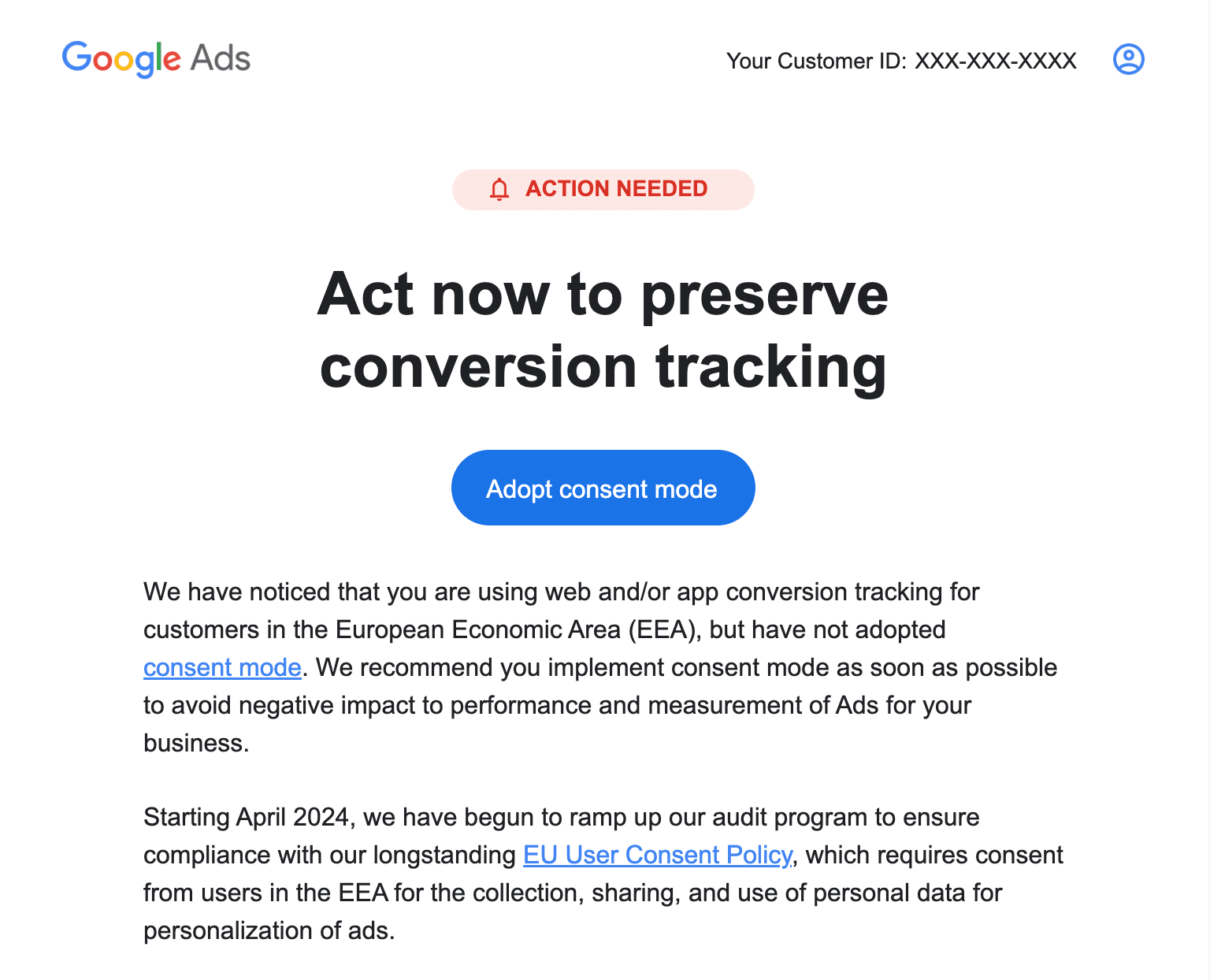
If you’ve received this notification, you’re not alone. Google is systematically auditing websites to ensure compliance with their consent requirements. The message is clear: implement Consent Mode now or lose access to conversion tracking data.
The enforcement timeline
Starting April 2024, Google began ramping up its audit program to ensure compliance with its longstanding EU User Consent Policy. This policy requires explicit consent from users in the European Economic Area (EEA) for the collection, sharing, and use of personal data for ad personalization.
The enforcement is not a future threat – it’s happening now. Website owners who haven’t adopted Consent Mode are already seeing their conversion tracking capabilities disabled, with direct consequences for their advertising campaigns and analytics insights.
What Consent Mode means for your business
Consent Mode is Google’s solution for balancing user privacy with marketing effectiveness. It adjusts how Google tags behave based on user consent choices, allowing you to:
- Respect user privacy preferences while maintaining measurement capabilities
- Continue receiving aggregated and modeled data even when users decline cookies
- Preserve conversion tracking for Google Ads campaigns
- Maintain compliance with privacy regulations like GDPR
Without Consent Mode implementation, you lose access to:
- Conversion tracking data in Google Ads
- Enhanced conversions and audience features
- Critical performance metrics for campaign optimization
- Remarketing capabilities for users who haven’t consented
Why Google-certified CMPs matter
Not all consent management platforms are created equal. Google-certified CMPs undergo rigorous testing to ensure they properly implement Consent Mode and communicate consent signals accurately to Google services.
Using a certified CMP like consentmanager provides several advantages:
- Guaranteed compatibility: Certified CMPs are tested and approved by Google, eliminating integration uncertainties
- Automatic updates: As Google evolves Consent Mode requirements, certified CMPs update accordingly
- Advanced consent modes: Support for both basic and advanced Consent Mode implementations
- Recovery of conversion data: Modeling capabilities that help recover up to 65% of conversion data when users decline cookies
Implementing Google Consent Mode with consentmanager
consentmanager supports Consent Mode v2 with the following integration options:
- Automatic Blocking Code
- Manual / Semiautomatic Blocking Code
- GTM (Google Tag Manager)
- inApp SDKs
These options allow you to adapt Consent Mode v2 to your technical setup, whether you prefer a fully automated approach, more manual control, or need SDK integration for mobile apps. Choosing the right option depends on your existing tag setup and compliance requirements. Regardless of the method, the goal is to ensure proper signal transmission to Google while respecting user consent choices.
How to enable Google Consent Mode in your consentmanager dashboard:
- Go to Menu > CMPs > Integrations and enable Google Consent Mode
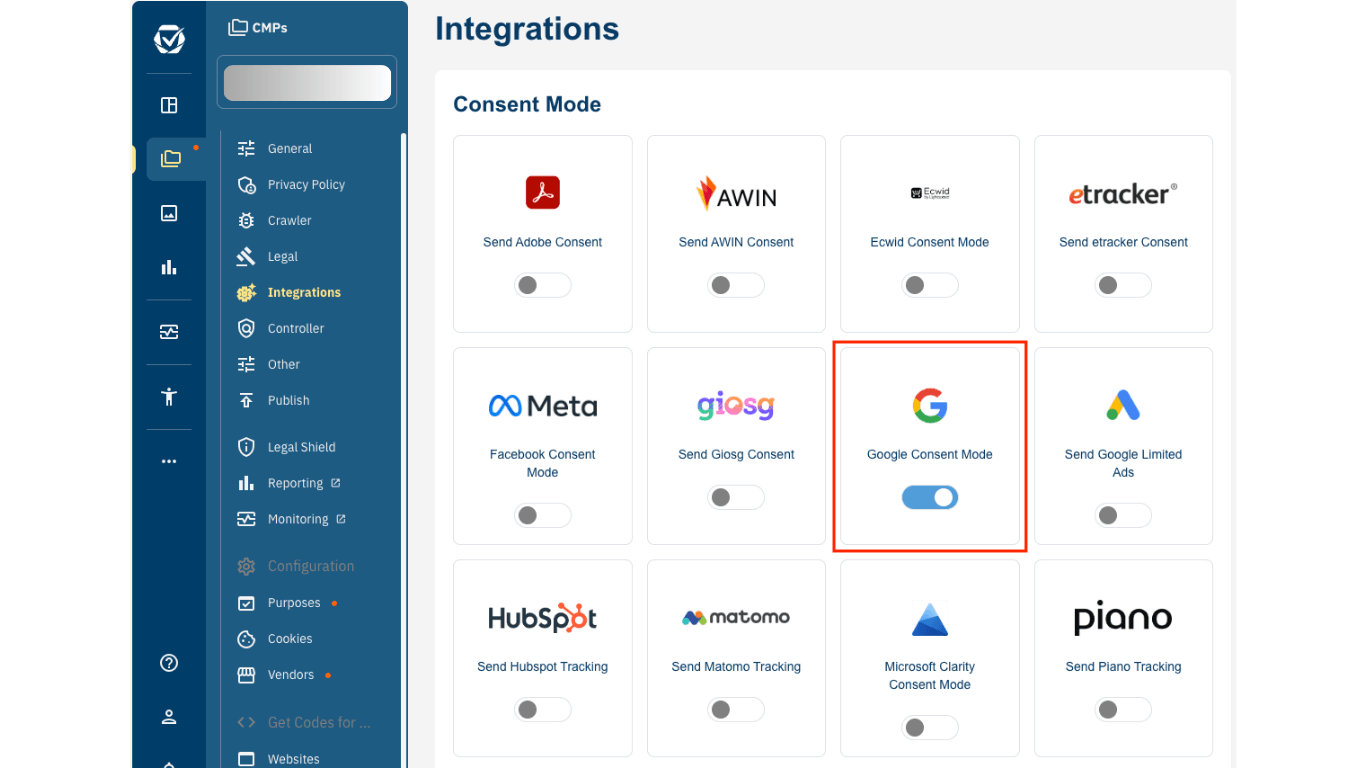
Be sure to add the relevant Google vendors to your CMP as well. Our help guide includes a step-by-step video tutorial showing you exactly how to set this up correctly.
Click here to access our complete guide: Working with Google Consent Mode
The consentmanager advantage
As a Google-certified CMP, consentmanager offers comprehensive Consent Mode v2 support with features designed to maximize both compliance and marketing performance:
- Automatic Consent Mode integration: Pre-configured settings for immediate compliance
- Machine learning optimization: AI-powered consent banner optimization to improve acceptance rates
- Multi-platform support: Consistent implementation across websites, mobile apps, and AMP pages
- Detailed analytics: Comprehensive reporting on consent rates and user preferences
- Regular updates: Continuous alignment with Google’s evolving requirements
- Proactive oversight: Compliance Monitor thoroughly scans websites and apps for privacy issues and provides guidance on how to mitigate them
Take action now
The window for voluntary compliance has closed. Websites without proper Consent Mode implementation face immediate consequences:
- Loss of conversion tracking data
- Reduced advertising effectiveness
- Inability to optimize campaigns
- Potential compliance violations
Don’t wait for Google to disable your tracking. Implementing a certified CMP ensures continuous data flow while respecting user privacy preferences.
Looking ahead
Google’s enforcement of Consent Mode represents a broader shift in digital marketing. Privacy-first approaches are becoming mandatory, not optional. Organizations that adapt quickly will maintain their competitive advantage, while those that delay face mounting challenges in measuring and optimizing their digital marketing efforts.
The choice is clear: implement Consent Mode now to preserve your marketing capabilities, or risk losing critical data that drives business decisions. With certified solutions like consentmanager, the transition can be smooth and the benefits immediate.
FAQs
- What happens if I don’t implement Consent Mode?
Google will disable conversion tracking for your website, meaning you’ll lose access to crucial data in Google Ads and Google Analytics. This affects your ability to measure campaign performance, optimize ad spend, and track ROI. Additionally, you won’t be able to use features like enhanced conversions, remarketing lists, and audience targeting.
- Is Consent Mode required for all websites?
Consent Mode is required for any website that uses Google Ads or Google Analytics and has visitors from the European Economic Area (EEA). Even if your business is based outside the EEA, you must implement Consent Mode if you have EEA visitors and use Google’s advertising or analytics services.
- How long does implementation take?
With a Google-certified CMP like consentmanager, basic implementation can be completed in as little as 30 minutes. This includes adding the CMP code to your website and configuring basic settings. More complex setups with custom designs, multiple domains, or specific regional requirements may take a few hours to properly configure and test.
- Will Consent Mode affect my conversion data accuracy?
When users grant consent, your data accuracy remains unchanged. When users decline cookies, Google uses modeling to estimate conversions based on aggregated data from similar users who did consent. While modeled data isn’t as precise as direct measurement, Google Consent Mode recovers conversion data on around 65% of ad clicks from users that didn’t consent. These modeled conversions provide valuable insights on ad performance, helping you get the most out of your ad budget.
- Can I use my existing cookie banner?
Only if your current solution is a Google-certified CMP that supports Consent Mode v2. Simple cookie notice banners or non-certified CMPs won’t properly communicate consent signals to Google services, leaving you non-compliant and at risk of losing tracking capabilities.
- What’s the difference between Consent Mode v1 and v2?
Consent Mode v2 introduces two additional consent types: ad_user_data and ad_personalization. These provide more granular control over how user data is used for advertising purposes. V2 is now required for all new implementations, and existing v1 implementations must upgrade to maintain compliance.
- Does Consent Mode work with other advertising platforms?
While Consent Mode is specific to Google services, many Google-certified CMPs, including consentmanager, support consent frameworks for other platforms like Facebook, Microsoft Advertising, and Amazon Ads. This allows you to manage all consent requirements through a single solution.
- How much does implementation cost?
With consentmanager, implementing or enabling Google Consent Mode is free for one website on our free plan or paid plan. For additional websites and app enablement, visit our pricing page to see exact rates. Our transparent pricing is based on the number of websites and traffic, with flexible plans designed for everything from small businesses to enterprise organizations. In most cases, the investment quickly pays for itself by preserving your marketing data and preventing the losses caused by missing conversion tracking.